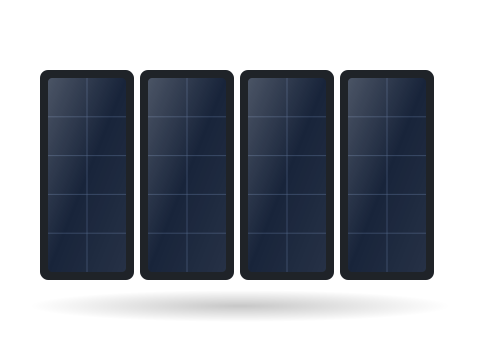
Renogy 200W Portable (N‑type)
Around half the price of brand‑name 200 W panels, with 25% N‑type cells, USB ports for phones and a 13.9 lb weight.
- Rated power
- 200W
- Efficiency
- 25%
- Weight
- 13.9lb
- Bifacial
- No
We earn a commission when you buy through our Amazon links, at no extra cost to you.
Renogy has made solar gear for RVs and off‑grid cabins for years, and this panel brings 16‑busbar N‑type cells rated at 25% efficiency to a budget price. It folds to roughly backpack size with a magnetic closure and weighs 13.9 lb.
Besides the MC4 output for power stations, it has a 45 W USB‑C port and two USB‑A ports to charge phones and tablets straight from the sun. Four kickstands give 40°, 50° and 60° angles, and it is listed to the UL 61730 safety standard. Its 21.6 V open‑circuit voltage suits most stations.
Pros
- Low price for a 25% N‑type panel
- Built‑in USB‑C and USB‑A charging
- Light and compact when folded
- UL 61730 safety listing
Cons
- The 4‑in‑1 adapter for other connectors is sold separately
- No published water‑resistance rating
- Single‑sided only
Who it’s for
- A first solar panel on a budget
- Charging phones and laptops directly at camp
- Adding a second panel to an existing setup
Technical specifications
| Rated power | 200 W |
|---|---|
| Efficiency | 25% |
| Cell type | N‑type 16BB |
| Bifacial | No |
| Weight | 13.9 lb (6.3 kg) |
| Power per kg | 31.7 W/kg |
| Folded size | 23.7 × 23.0 × 2.0 in |
| Open‑circuit voltage (Voc) | 21.6 V |
| Connector | MC4 |
| Water resistance | — |
| USB charging | USB‑C 45 W + 2× USB‑A |
Performance profile
Scores are calculated from published specs on a 0–10 scale. Versatility adds points for bifacial cells, built‑in USB, IP68 and standard MC4 connectors.
How fast does it charge each station?
| Station | Capacity | Time to full |
|---|---|---|
| EcoFlow RIVER 3 * | 245 Wh | 3.2 hlimited by station input (110 W) |
| Anker SOLIX C300 DC * | 288 Wh | 4.1 hlimited by station input (100 W) |
| Jackery Explorer 500 v2 | 512 Wh | 3.7 h |
| EcoFlow DELTA 3 Plus | 1,024 Wh | 7.3 h |
| Anker SOLIX C1000 Gen 2 | 1,024 Wh | 7.3 h |
| BLUETTI Elite 100 V2 | 1,024 Wh | 7.3 h |
| EcoFlow DELTA 3 Classic | 1,024 Wh | 7.3 h |
| DJI Power 1000 V2 | 1,024 Wh | 7.3 h |
| Jackery Explorer 1000 v2 | 1,070 Wh | 7.6 h |
| BLUETTI AC180 | 1,152 Wh | 8.2 h |
| Jackery Explorer 2000 v2 | 2,042 Wh | 15 h |
| DJI Power 2000 | 2,048 Wh | 15 h |
| BLUETTI Elite 200 V2 | 2,074 Wh | 15 h |
| Anker SOLIX F3000 | 3,072 Wh | 22 h |
| EcoFlow DELTA Pro 3 | 4,096 Wh | 29 h |
Estimated at 70% of rated power to account for clouds, angle and heat. Stations marked * accept less solar power than the panel can give, so they cap the speed.
Before you buy: check that the panel’s connector fits your station (or buy the adapter) and that its open‑circuit voltage (Voc) is within the station’s solar input range. Panels can be wired in series or parallel to add power if the station allows it.
What reviewers and owners say
Owners highlight the efficiency for the price, the light weight and the handy USB ports. The main complaint is needing an extra adapter for some power stations. On Amazon it averages 4.5 out of 5 across nearly 1,000 ratings.
Sources: Amazon
Renogy 200W Portable (N‑type)
Around half the price of brand‑name 200 W panels, with 25% N‑type cells, USB ports for phones and a 13.9 lb weight.