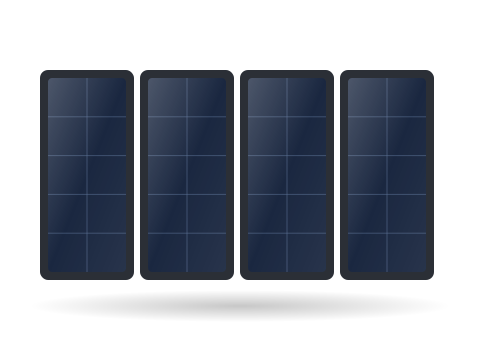
EcoFlow 400W Portable
Twice the power of a 200 W panel from a single unfold, IP68 rated. Heavy at 35 lb, and best matched to stations with 500 W+ solar input.
- Rated power
- 400W
- Efficiency
- 22.6%
- Weight
- 35.3lb
- Bifacial
- No
We earn a commission when you buy through our Amazon links, at no extra cost to you.
One unfold gives you 400 W, so you avoid wiring two panels together. It is IP68 rated, folds into a case that doubles as a kickstand with 30°, 45° and 60° angles, and runs at 48 V open‑circuit, which suits stations with a 12–60 V input range.
Mighty Gadget saw peaks of about 305 W, mostly 150–250 W, under cloudy UK skies and nearby buildings, and rated it 90%. The trade‑offs: 35.3 lb, about 42 lb with the case, no carry handles once unpacked, and a price closer to that of a small power station.
Pros
- 400 W from a single panel
- IP68 rated
- Good output even in poor light
- Folds thin for its size
Cons
- Heavy (35.3 lb panel only)
- Expensive
- Fiddly setup, no handles when unpacked
- 48 V is too high for some small stations
Who it’s for
- EcoFlow DELTA owners with 500 W+ solar input
- RV and off‑grid setups that stay in one place
- Refilling 2 kWh stations in a single day
Technical specifications
| Rated power | 400 W |
|---|---|
| Efficiency | 22.6% |
| Cell type | Monocrystalline |
| Bifacial | No |
| Weight | 35.3 lb (16 kg) |
| Power per kg | 25 W/kg |
| Folded size | — |
| Open‑circuit voltage (Voc) | 48 V |
| Connector | MC4 (XT60 cable) |
| Water resistance | IP68 |
| USB charging | No |
Performance profile
Scores are calculated from published specs on a 0–10 scale. Versatility adds points for bifacial cells, built‑in USB, IP68 and standard MC4 connectors.
How fast does it charge each station?
| Station | Capacity | Time to full |
|---|---|---|
| EcoFlow RIVER 3 * | 245 Wh | 3.2 hlimited by station input (110 W) |
| Anker SOLIX C300 DC * | 288 Wh | 4.1 hlimited by station input (100 W) |
| Jackery Explorer 500 v2 * | 512 Wh | 3.7 hlimited by station input (200 W) |
| EcoFlow DELTA 3 Plus | 1,024 Wh | 3.7 h |
| Anker SOLIX C1000 Gen 2 | 1,024 Wh | 3.7 h |
| BLUETTI Elite 100 V2 | 1,024 Wh | 3.7 h |
| EcoFlow DELTA 3 Classic | 1,024 Wh | 3.7 h |
| DJI Power 1000 V2 | 1,024 Wh | 3.7 h |
| Jackery Explorer 1000 v2 | 1,070 Wh | 3.8 h |
| BLUETTI AC180 | 1,152 Wh | 4.1 h |
| Jackery Explorer 2000 v2 | 2,042 Wh | 7.3 h |
| DJI Power 2000 | 2,048 Wh | 7.3 h |
| BLUETTI Elite 200 V2 | 2,074 Wh | 7.4 h |
| Anker SOLIX F3000 | 3,072 Wh | 11 h |
| EcoFlow DELTA Pro 3 | 4,096 Wh | 15 h |
Estimated at 70% of rated power to account for clouds, angle and heat. Stations marked * accept less solar power than the panel can give, so they cap the speed.
Before you buy: check that the panel’s connector fits your station (or buy the adapter) and that its open‑circuit voltage (Voc) is within the station’s solar input range. Panels can be wired in series or parallel to add power if the station allows it.
What reviewers and owners say
Mighty Gadget called it “massive, expensive and amazing”: the highest output of the portable panels they covered, but heavy and fiddly. On Amazon it averages 4.2 out of 5.
Sources: Mighty Gadget
EcoFlow 400W Portable
Twice the power of a 200 W panel from a single unfold, IP68 rated. Heavy at 35 lb, and best matched to stations with 500 W+ solar input.