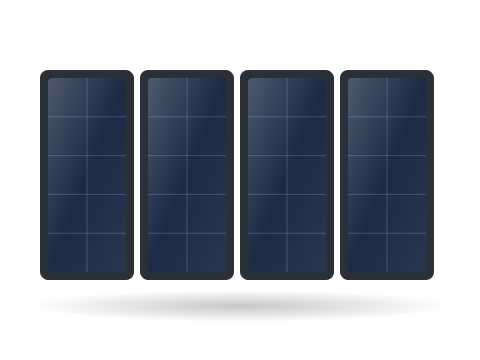
EcoFlow 220W Bifacial
Light for its output, bifacial, IP68 and with a built‑in angle guide. The easiest panel to recommend for 1–2 kWh stations.
- Rated power
- 220W
- Efficiency
- 25%
- Weight
- 15.4lb
- Bifacial
- Yes
We earn a commission when you buy through our Amazon links, at no extra cost to you.
EcoFlow’s 220 W panel uses N‑type cells rated at up to 25% efficiency and collects light on both sides, which EcoFlow says adds up to 28% more energy over reflective ground. It weighs 15.4 lb in its current version and folds into a case that doubles as a stand with a 30–60° adjustable angle and a sun‑angle guide.
Mighty Gadget hit the full 220 W peak on both a RIVER 2 MAX and a DELTA 2. Its low 21.8 V open‑circuit voltage suits almost any power station, including small units with limited input voltage, and two of them can be wired in series for stations with higher voltage ranges.
Pros
- Reached its full 220 W rating in tests
- Bifacial N‑type cells, up to 25% efficiency
- IP68 and ETFE coating
- Low voltage works with almost any station
Cons
- The bag‑stand takes practice to set up
- No USB ports for direct charging
- Non‑EcoFlow stations may need an MC4 adapter
Who it’s for
- Pairing with any 1–2 kWh power station
- Camping on sand, snow or light ground where bifacial gains are real
- Buyers who want one panel that does it all
Technical specifications
| Rated power | 220 W |
|---|---|
| Efficiency | 25% |
| Cell type | N‑type |
| Bifacial | Yes |
| Weight | 15.4 lb (7 kg) |
| Power per kg | 31.4 W/kg |
| Folded size | 23.2 × 24.2 × 1.3 in |
| Open‑circuit voltage (Voc) | 21.8 V |
| Connector | MC4 |
| Water resistance | IP68 |
| USB charging | No |
Performance profile
Scores are calculated from published specs on a 0–10 scale. Versatility adds points for bifacial cells, built‑in USB, IP68 and standard MC4 connectors.
How fast does it charge each station?
| Station | Capacity | Time to full |
|---|---|---|
| EcoFlow RIVER 3 * | 245 Wh | 3.2 hlimited by station input (110 W) |
| Anker SOLIX C300 DC * | 288 Wh | 4.1 hlimited by station input (100 W) |
| Jackery Explorer 500 v2 * | 512 Wh | 3.7 hlimited by station input (200 W) |
| EcoFlow DELTA 3 Plus | 1,024 Wh | 6.6 h |
| Anker SOLIX C1000 Gen 2 | 1,024 Wh | 6.6 h |
| BLUETTI Elite 100 V2 | 1,024 Wh | 6.6 h |
| EcoFlow DELTA 3 Classic | 1,024 Wh | 6.6 h |
| DJI Power 1000 V2 | 1,024 Wh | 6.6 h |
| Jackery Explorer 1000 v2 | 1,070 Wh | 6.9 h |
| BLUETTI AC180 | 1,152 Wh | 7.5 h |
| Jackery Explorer 2000 v2 | 2,042 Wh | 13 h |
| DJI Power 2000 | 2,048 Wh | 13 h |
| BLUETTI Elite 200 V2 | 2,074 Wh | 13 h |
| Anker SOLIX F3000 | 3,072 Wh | 20 h |
| EcoFlow DELTA Pro 3 | 4,096 Wh | 27 h |
Estimated at 70% of rated power to account for clouds, angle and heat. Stations marked * accept less solar power than the panel can give, so they cap the speed.
Before you buy: check that the panel’s connector fits your station (or buy the adapter) and that its open‑circuit voltage (Voc) is within the station’s solar input range. Panels can be wired in series or parallel to add power if the station allows it.
What reviewers and owners say
Mighty Gadget found it outperformed one‑sided panels at no extra cost and was far easier to handle than EcoFlow’s 400 W panel, with the stand‑bag the only real annoyance. On Amazon it averages 4.5 out of 5 across more than 700 ratings.
Sources: Mighty Gadget
EcoFlow 220W Bifacial
Light for its output, bifacial, IP68 and with a built‑in angle guide. The easiest panel to recommend for 1–2 kWh stations.